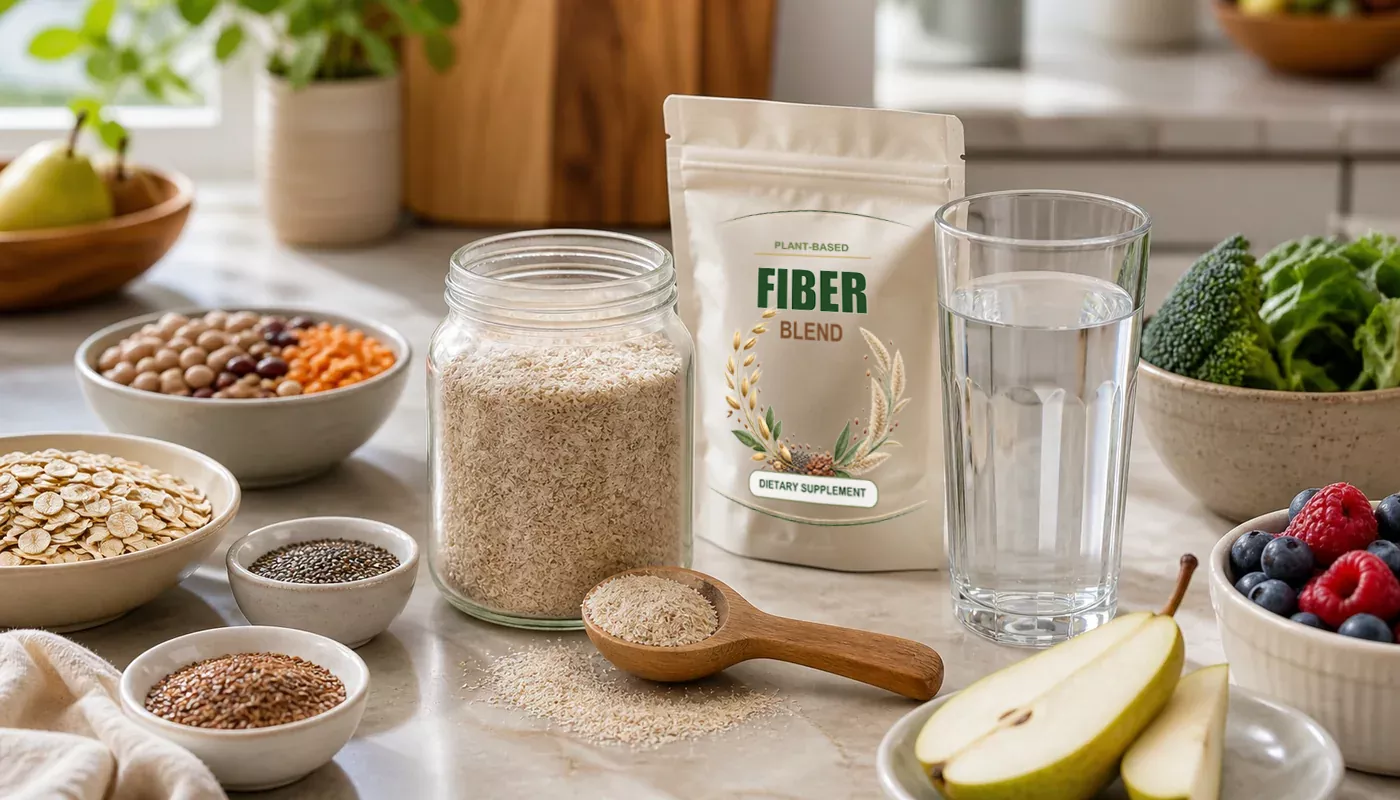
Fiber: The Supplement Category Almost Nobody Talks About
Highlights
- Fiber supports more than bowel regularity, but different types have different effects.
- Psyllium can help with constipation and modestly lower LDL cholesterol; not every fiber product offers the same benefits.
- Food provides fiber alongside other useful nutrients, while a supplement can help fill a specific gap.
- Increase gradually, follow fluid instructions, and check medication timing rather than taking a large amount all at once.
Fiber is rarely the glamorous guest in the supplement aisle. It does not usually promise laser focus, ageless skin, or a workout worthy of a film montage. Its packaging often seems content to discuss regularity, which is useful but unlikely to launch a lifestyle empire.
That modest reputation undersells it. Fiber plays several roles in digestion, and certain forms can also help with cholesterol or blood glucose management. The important detail is that fiber is a category, not one identical ingredient.
A powder that dissolves invisibly into coffee may behave differently from one that forms a thick gel in water. Understanding those differences helps you choose something useful instead of simply adding another scoop to the day.
Fiber is a category, not an ingredient. Two products offering five grams can do quite different jobs.
The short version
What Counts as Fiber?
Dietary fiber includes components of plant foods that resist digestion in the small intestine. Some reach the colon and are fermented by microbes; others retain more of their structure as they move through the digestive tract.
Whole foods contain mixtures of fibers, often alongside vitamins, minerals, protein, and other plant compounds. Supplements usually supply a narrower selection, sometimes extracted from plants or manufactured to have particular properties.
That does not make added fiber automatically inferior. A well-chosen isolated fiber can have a useful effect. But the benefit depends on the ingredient, its physical properties, and how much is supplied.
A fiber number on a label is therefore a starting point rather than a complete description. Two products offering five grams can differ in how they influence stool, fermentation, fullness, or cholesterol. The word fiber is doing a lot of work on that small panel.
How Much Are You Getting Already?
On U.S. food labels, the Daily Value for fiber is 28 grams, based on a 2,000-calorie diet. Individual needs vary with age and energy intake, so this is a useful reference rather than a compulsory number for every person.
It includes food and supplements combined. A supplement serving does not need to provide the entire day's amount, and a high-fiber breakfast does not mean the rest of the diet no longer matters.
Before buying anything, look at a few ordinary days. Do they include beans, whole grains, fruit, vegetables, nuts, or seeds? Which meals consistently have very little fiber? A label check can reveal a gap more clearly than assuming that a meal is high in fiber because it looks healthy.
For example, replacing some refined cereal with oats or adding beans to a familiar soup may make a useful difference. Start with the meals you already eat instead of designing a completely new menu that disappears by Thursday.
Soluble and Insoluble Are Only Part of the Story
Soluble fiber interacts with water, while insoluble fiber does not dissolve in the same way. Those terms are familiar, but they do not tell you everything about what a fiber will do.
Viscosity describes how thick a fiber becomes in liquid. Gel-forming fibers can affect the movement and absorption of nutrients in the gut. Fermentability describes how readily microbes break a fiber down, which can influence both useful fermentation products and gas production.
These properties overlap. A soluble fiber may be highly fermentable without forming the kind of gel associated with cholesterol lowering. An insoluble fiber may add bulk without offering the same effects as a viscous soluble fiber.
You do not need to memorize the chemistry. The practical lesson is to match the ingredient to the intended outcome. Clear mixing and a pleasant texture are useful product features, but neither proves that a powder does the job you want.
Psyllium Has More Than One Practical Use
Psyllium comes from the husks of Plantago ovata seeds. It absorbs water and forms a gel, which helps explain why it has a well-established place among fiber supplements.
For some people with constipation, it can improve stool consistency and make bowel movements easier. It may be especially useful when dietary fiber is low, although constipation has several possible causes and does not always respond to more bulk.
Psyllium can also modestly lower LDL cholesterol when used consistently in an appropriate amount. That is a specific benefit of a particular fiber, not a promise that every product labeled soluble fiber has an equal effect.
It does not replace cholesterol medication when medication is needed. Nor does a lower LDL measurement establish that a particular supplement prevents heart attacks on its own. It can be one helpful part of a broader plan, alongside food choices and any indicated treatment.
Other Ingredients Have Different Strengths
Inulin and related fructans are readily fermented and can serve as prebiotic ingredients. They are often added to powders, bars, and other foods. Their ability to feed certain microbes does not make them interchangeable with psyllium for every purpose.
Fermentation can also produce gas. If a protein bar or high-fiber snack repeatedly leaves you uncomfortable, check whether a substantial amount of inulin or chicory-root fiber is included. The reaction may relate to the amount rather than the entire idea of fiber being wrong for you.
Methylcellulose is less readily fermented and is used as a bulk-forming product. Wheat dextrin and other soluble fibers may mix easily, but convenience does not establish the same cholesterol-lowering or constipation effects as a gel-forming preparation.
The strongest choice is not necessarily the newest ingredient. It is the one with a plausible benefit for your goal, acceptable tolerance, and instructions you can follow consistently. Product categories are useful; automatic rankings are less so.
Let Your Gut Catch Up
A common mistake is adding a large fiber serving to a diet that previously contained very little. The intention is good. The resulting gas can be less enthusiastic.
Increase gradually and follow the product's starting instructions. If discomfort appears, reassess the amount and ingredient rather than assuming you need to push through. A smaller change that feels comfortable can be easier to sustain.
Keep an eye on the total from multiple products. A morning powder, two fortified snack bars, and a new prebiotic drink may add much more than you realize. Their combined effect matters even when each package looks modest.
Allow the routine to settle before making another change. More comfortable, easier bowel movements are a better outcome than forcing a particular number of daily trips to the bathroom. Normal frequency varies, and straining or discomfort often tells you more than the calendar alone.
Water Instructions Are Part of the Product
Psyllium must be taken with enough liquid. Powder or granules are commonly mixed with at least eight ounces, about 240 milliliters, immediately before use; follow the specific package directions. Never swallow the powder dry.
The same swelling that makes the fiber useful can create a choking or blockage risk if it is taken incorrectly. Capsules also require adequate liquid, and the full serving may involve several capsules.
Do not use a bulk-forming supplement on your own if you have swallowing difficulty or a known intestinal narrowing or obstruction. New difficulty swallowing, chest discomfort, or breathing trouble after taking it needs urgent attention.
For everyday hydration, needs vary with health, activity, and weather. If you have a medical fluid restriction, ask how the supplement fits that plan rather than simply adding large amounts of water. There is no advantage in treating the liquid instruction as optional fine print.
This is the one instruction on the label that is not a suggestion. Psyllium swells, so mix it with the full liquid stated, commonly eight ounces, and never swallow it dry. Do not use a bulk-forming supplement at all if you have swallowing difficulty or a known narrowing of the bowel.
A Spoonful Does Not Replace the Rest of the Meal
A supplement can fill a gap, but it does not reproduce all the qualities of fiber-rich food. Beans provide protein, fruit provides water and micronutrients, and nuts supply unsaturated fats alongside their fiber.
Aim to retain those foods where they fit your needs. Useful combinations can be simple: oats with fruit, a bean-filled wrap, whole-grain toast with hummus, or vegetables added to pasta and rice dishes.
Food texture and tolerance matter too. Cooked vegetables, soups, and smaller portions of legumes may be easier for some people than large raw salads. There is no requirement to eat every fiber source in its crunchiest form.
If a digestive condition limits food choices, the plan may need more individual adjustment. During certain disease flares or with significant narrowing of the bowel, adding more fiber can be inappropriate. A flexible nutrition approach is more useful than applying a single slogan to every gut.
Check the Label and the Medication Schedule
Look for the named fiber ingredient and grams of actual dietary fiber per serving. The weight of the whole scoop can include flavoring and other ingredients. Also check how many capsules, gummies, or teaspoons make up that serving.
Compare cost per useful serving rather than only the size of the container. A cheaper package may contain fewer effective servings, while a premium blend may charge extra for ingredients you do not need.
Fiber supplements can alter the absorption of some medicines. The required separation depends on the medication and product, so use their instructions or a pharmacist's advice rather than a universal timing rule. This is especially important when you already have a carefully scheduled medication routine.
Sugar alcohols or added prebiotics can affect tolerance independently of the main fiber. If one formula does not suit you, that does not establish that every fiber supplement will behave the same way.
What the panel should tell you before you buy
- The named fiber ingredient, not just the word fiber
- Grams of actual dietary fiber per serving, separate from the scoop weight
- How many teaspoons, capsules or gummies make one serving
- Cost per useful serving rather than the size of the container
- Any added inulin or sugar alcohols, which affect tolerance on their own
- How it should be spaced from your medicines, which varies by drug
Know When More Fiber Is Not the Next Step
Persistent constipation may involve medication effects, pelvic-floor coordination, slow transit, or other causes. Repeatedly increasing a supplement can leave the underlying problem untouched while making bloating worse.
Blood in stool, unexplained weight loss, severe abdominal pain, vomiting, or inability to pass gas needs assessment rather than a larger dose. Fiber is not a treatment for an intestinal blockage, and new persistent bowel changes deserve attention.
For an ordinary dietary gap, however, the plan can remain simple: add a tolerable amount, use it correctly, and notice whether the intended outcome improves. If cholesterol is the goal, progress is assessed over time with appropriate follow-up, not by whether your stomach feels different after a serving.
Fiber may never have the dramatic appeal of a supplement promising to transform your life. It does not need to. Easier digestion, a better food pattern, or a modest improvement in a relevant health marker can be quite enough to justify its place.
Comfortable is the outcome worth chasing. A particular number of daily trips is not.
Worth remembering